Posts

Showing posts with the label Locanam 3D Printing in Delhi

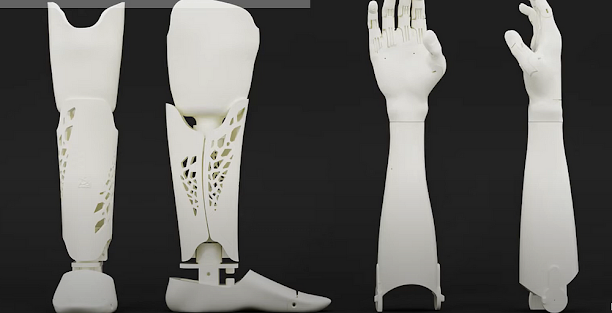
The Future of 3D Printing in Patient-Specific Prosthetics and Implants
Image
  According to Karsten Schlichter, global business development manager at Elkem Silicones, 3D printing offers greater flexibility and variability compared to traditional casting. Unlike casting, which involves creating molds for each item, 3D printing allows for more versatile manufacturing. Adjusting a mold manually lacks the precision of digital modeling. Each modification requires testing, success saves time, but failure restarts the iterative process, costing both time and money. With 3D printing, Schlichter highlights significant time savings, reportedly over 70%. This technology enables swift progression from concept to prototype to final product by allowing rapid iterations directly on the digital model, expediting the entire development process. FOR MORE -  The Future of 3D Printing in Patient-Specific Prosthetics and Implants
Image
  3D printing has transcended its initial use in prototyping to revolutionize full-scale manufacturing and the production of high-quality finished products. Initially developed for aerospace prototyping, 3D printing now significantly impacts various industries, including healthcare and cosmetics. This technology enhances the flexibility of manufacturing sites and lines, making supply chains more agile. Traditional manufacturing relies on product-specific tooling, necessitating retooling for product modifications or variations. In contrast, 3D printing eliminates the need for tooling. A single 3D printing system can produce a wide range of products using various materials, thereby increasing production line flexibility and speeding up time to market. Supply chains that incorporate 3D printing become more agile, resilient to unexpected disruptions, and better equipped to respond to market demand changes. Processes like CNC milling or injection molding in traditional manufacturing req...

How Artificial Intelligence is Revolutionizing Additive Manufacturing

Image
  Additive manufacturing is one of the key areas of manufacturing in which artificial intelligence is making an impact. The two technologies — AI and additive manufacturing — have risen sharply in adoption over the past several years, and we are now seeing the benefits that they can yield by working together. AI in additive manufacturing is providing quality improvements, boosts to innovation and productivity, and has an overall positive impact on profit margins and the bottom line. FOR MORE -  How Artificial Intelligence is Revolutionizing Additive Manufacturing

3D Printing Blog | Locanam Blog Post

Image
  The Locanam Blog is your go-to source for the latest developments in the 3D printing industry. We explore the dynamic interplay between 3D printing technology and various sectors, keeping you informed about groundbreaking innovations and trends. 3D Printing Blog | Locanam Blog Post

WHAT IS POWDER BED FUSION

Image
Powder Bed Fusion (PBF) stands as a notable Additive Manufacturing (AM) technique, characterized by its layer-by-layer approach to creating objects. With its potential applications across automotive, aerospace, energy sectors, and household appliances, PBF represents a pivotal future manufacturing method. Alongside PBF, other AM methods like Laminated Object Manufacturing, Direct Energy Deposition, Stereolithography (SLA), and Solid Ground Curing (SGC) contribute to the diverse landscape of additive manufacturing. This overview will focus on the mechanics of the PBF process, particularly highlighting Direct Metal Laser Deposition (DMLS), Selective Laser Sintering (SLS), Selective Laser Melting (SLM), Electron Beam Melting (EBM), and Selective Heat Sintering (SHS). In these techniques, a layer of powder is spread onto a platform, often referred to as the build platform. While SLS, SLM, and DMLS employ lasers as the primary heat source, EBM utilizes an electron beam. SHS, on the other ha...

What is Binder Jetting 3D Printing?

Image
3D printing, also called additive manufacturing (AM), is an innovative technique that sequentially builds components or products by layering materials. Unlike traditional methods, it doesn't require subtracting materials to form molds or shapes. This allows for the creation of complex, specific, and previously impossible designs. Despite being a relatively new technology, 3D printing has seen extensive research and publications since 2014. It's now being adopted across various industries, challenging conventional manufacturing methods. There are two main categories of 3D printing: fusion-based methods like Powder Bed Fusion (PBF) and Directed Energy Deposition (DED), and non-fusion methods such as Binder Jetting (BJ). This discussion will focus on binder jetting technology. FOR MORE - https://www.locanam.com/post/what-is-binder-jetting https://www.locanam.com/post/what-is-binder-jetting

3D Printing Metal Materials Market size to grow by USD 2,396.67 million from 2022 to 2027 !

Image
  The 3D printing metal materials market size is estimated to increase by USD 2,396.67 million from 2022 to 2027, with a CAGR of 25.7% , according to a recent market study by Technavio. This report also offers a 5-year historical (2017-2021) data projection of market size, segmentation, and region. 3D Printing Metal Materials Market – Market Segmentation. The market is segmented by end-user (medical and healthcare, automotive, aerospace and defense, tool and mold making, and others), type (titanium, stainless steel, nickel, aluminum, and others) A thorough analysis of the market's competitive landscape and detailed information about vendors. Comprehensive analysis of factors that will challenge the growth of 3D printing metal materials market vendors. What are the key data covered in this 3D Printing Metal Materials Market report? CAGR of the market during the forecast period Detailed information on factors that will drive the growth of the 3D printing metal materials market be...